
Need a Document Notarized? Start Here
Different documents require different services. Some need a signature witnessed, while others require an oath, declaration or certified true copy. Vertex Legal Solutions helps you identify what your document needs before the appointment, so you can avoid delays, repeat visits and incomplete paperwork.





Notary Public or Commissioner for Oaths: Which Do You Need?
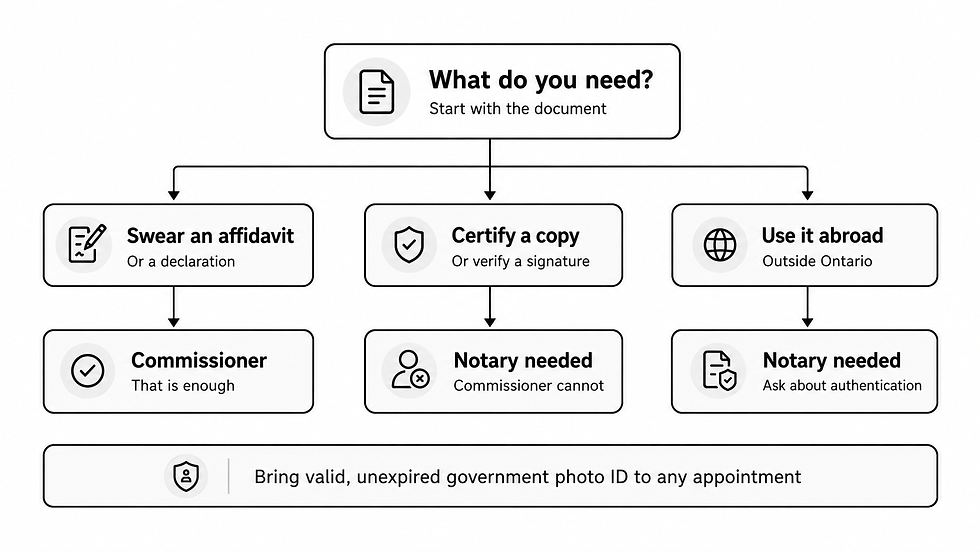
It is common to be unsure which service your document requires. A commissioner for oaths can administer an oath, affirmation or declaration, while a notary public can also verify signatures and certify copies of documents as genuine. Vertex reviews your document requirements and helps you book the appropriate service.
Frequently Asked Questions
Find clear answers to common questions about notarization, affidavits, certified copies, identification and commissioner for oaths services in Ontario.

A notary public witnesses signatures, administers oaths and affirmations, and certifies that documents or copies are true and accurate. Common notarial services include affidavits, statutory declarations, certified true copies, and authenticating documents for use in Canada or abroad.
A commissioner of oaths can witness signatures and administer oaths for documents used within Ontario, while a notary public has broader authority, including certifying documents for use outside the province or internationally. If your document is going to another country, you generally need a notary rather than a commissioner.
An affidavit is a written statement of facts sworn or affirmed to be true, signed in front of a person authorized to take oaths, such as a notary public, commissioner, or lawyer. Affidavits are commonly required for court proceedings, government applications, financial matters, and situations where a sworn account of facts is needed as evidence.
A statutory declaration is a formal written statement declared to be true outside of a courtroom, typically used for administrative, business, or personal matters rather than litigation. An affidavit is usually made specifically for use in a court proceeding, while a statutory declaration serves a broader range of everyday legal and administrative purposes.
A certified true copy is a photocopy of an original document that has been
stamped, signed, and confirmed by an authorized person, such as a notary
public, to be an accurate reproduction of the original. Certified copies are
often required for immigration applications, school enrolment, financial
institutions, and submissions to foreign governments.Yes. To certify a copy as true, the notary must compare it directly against the original document, so you'll need to bring the original with you to your appointment. Copies certified without sight of the original are not valid.
In many cases, yes, though some countries require an additional step called authentication or legalization (and sometimes an apostille) after notarization before the document will be accepted abroad. Requirements vary by country and document type, so it's worth confirming what the receiving country or institution requires before your appointment.
No. For affidavits, statutory declarations, and other sworn documents, you must sign in front of the notary, not beforehand, since the notary is witnessing that you personally signed and swore to its contents. Signing in advance can require you to re-sign at your appointment.
You'll generally need government-issued photo identification, such as a
driver's licence or passport, so the notary can confirm your identity before
witnessing your signature. Requirements can vary slightly depending on the document, so it's best to confirm what to bring when booking your
appointment.Notary fees vary depending on the type of document, the number of signatures or copies required, and the complexity of the request. Many notaries, including our office, can provide a clear fee before your appointment once you describe what you need notarized.