

Speeding Tickets in Ontario
Received a speeding ticket in Ontario? Before you pay the fine or choose how to respond, understand how the charge may affect your demerit points, driving record, licence or work.
We review your ticket, explain your options in simple terms and help you through the Provincial Offences Court process.
What is the charge?
Driving faster than the posted limit. Ontario has no tolerance built into the law — the charge is available from 1 km/h over, and enforcement discretion is exactly that: discretion, not a rule you can rely on.
Fines scale with your speed and are multiplied in community safety zones and construction zones — a common and expensive surprise for drivers who did not notice the signage. At high enough speeds the matter proceeds as a Part III summons rather than a set-fine ticket, which means a court appearance and a much larger fine range.
Above certain margins, speeding stops being a speeding ticket and becomes stunt driving under s. 172: 40 km/h or more over where the posted limit is under 80 km/h, 50 km/h or more over where it is 80 km/h or higher, or 150 km/h or more anywhere. That is a different charge with a roadside licence suspension and vehicle impound before you ever see a courtroom. If your speed is near one of those lines, the section cited on your ticket is the first thing to check.
The fine is usually the smallest part of the bill. A speeding conviction sits on your record for three years and is visible to insurers, and moving from the 0-point bracket into the 3-point bracket is often the difference between a renewal that looks normal and one that does not. The gap between 15 and 16 km/h over is a few seconds of driving and a multi-year cost.
Demerit Points by Speed
Speed Over the Posted Limit | Demerit Points |
|---|---|
1–15 km/h | 0 points |
16–29 km/h | 3 points |
30–49 km/h | 4 points |
50 km/h or more | 6 points |


Send us a copy of your speeding ticket or summons, along with the basic details of your driving situation. We check the response deadline and confirm the next step.

We review the alleged speed, posted speed limit, licence type, driving history and possible consequences. Where available, we also examine disclosure, officer notes and radar, lidar or other speed evidence.

Send us a copy of your speeding ticket or summons, along with the basic details of your driving situation. We check the response deadline and confirm the next step.

Fines
Fines scale with your speed and are multiplied in community safety zones and construction zones - a common and expensive surprise for drivers who did not notice the signage. At high enough speeds the matter proceeds as a Part III summons rather than a set-fine ticket, which means a court appearance and a much larger fine range.

The threshold that changes everything
Above certain margins, speeding stops being a speeding ticket and becomes stunt driving under s. 172: 40 km/h or more over where the posted limit is under 80 km/h, 50 km/h or more over where it is 80 km/h or higher, or 150 km/h or more anywhere. That is a different charge with a roadside licence suspension and vehicle impound before you ever see a courtroom. If your speed is near one of those lines, the section cited on your ticket is the first thing to check.
Why this one is worth a look?
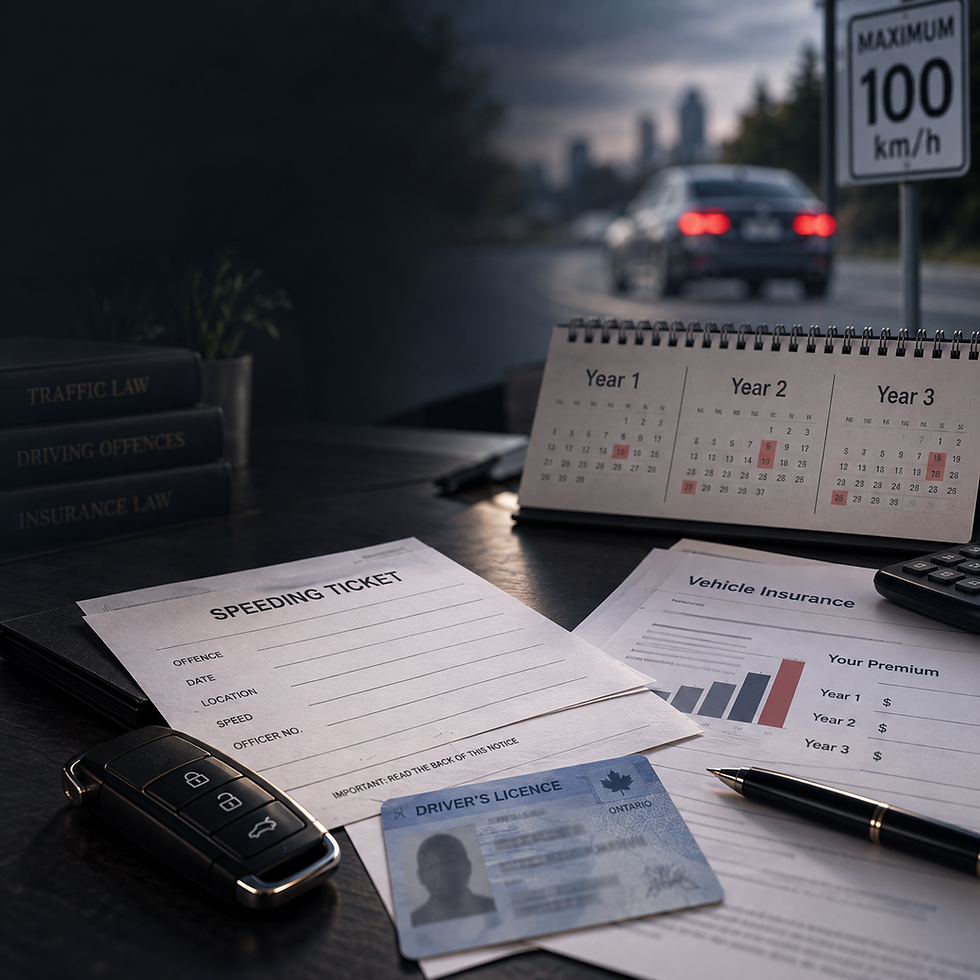
The fine is usually the smallest part of the bill. A speeding conviction sits on your record for three years and is visible to insurers, and moving from the 0-point bracket into the 3-point bracket is often the difference between a renewal that looks normal and one that does not. The gap between 15 and 16 km/h over is a few seconds of driving and a multi-year cost.
What Ontario Drivers Say About Our Service
Daniel R., Toronto
“I contacted Vertex Legal Solutions after receiving a speeding ticket in Toronto. They reviewed the alleged speed, possible demerit points and my driving record before explaining my options. The Provincial Offences Court process was handled professionally, and I received clear updates throughout.”
Aiden P., Mississauga
“I was worried that a speeding-ticket conviction could affect my G2 licence. The team explained the Ontario novice-driver rules in simple language, reviewed my ticket and helped me understand whether early resolution or a trial request was more suitable.”
Michael T., Brampton
“As a commercial driver, I needed to understand how the speeding charge could affect my driver abstract and employment. Vertex reviewed the disclosure, driving history and work-related concerns carefully. Their advice was practical, organised and easy to understand.”
Sarah M., Hamilton
“Vertex Legal Solutions reviewed the officer’s notes, ticket details and available speed-measuring evidence connected to my case. They explained the radar and disclosure information clearly and prepared me for the next stage of the Ontario traffic-ticket process.”
Jason K., Ottawa
“I already had earlier traffic convictions, so I was concerned about receiving more demerit points. Vertex considered my full driving record instead of looking only at the new speeding ticket. Their clear guidance helped me make a more informed decision.”
Emily S., London
“My speeding-ticket matter required representation in Provincial Offences Court. Vertex managed the documents, communication and case preparation professionally. I always knew what had been completed, what was required from me and what the next court step would be.”
Fighting it
A speeding charge rests on the accuracy and proper use of the measuring device, the officer's identification of your vehicle, and the correctness of the ticket itself. Disclosure — the prosecution's file - tells you which of those is actually solid in your case. You have three ways to respond: pay (a guilty plea and conviction), meet the prosecutor at early resolution, or elect trial.
